Coming Soon
Lashey Lewis
•
AI search is fundamentally changing how SaaS companies get discovered online. For years, SEO was driven by traditional search engines like Google — where keywords, backlinks, and on-page optimization were enough to secure visibility. But with the rise of AI Overviews, conversational search, and answer-based engines like ChatGPT Search, Perplexity, and Gemini, the rules have changed.
Today, SaaS brands are realizing something critical:
Your future customers won’t “search” the way they used to — they will ask AI.
And if your content isn’t built for AI systems to understand, trust, and extract from… you disappear.
This blog breaks down how AI search works, why BOFU content matters more than ever, and how modern SaaS marketers can adapt their strategy.
What Is AI Search?
AI search refers to search experiences powered by large language models (LLMs) instead of traditional keyword-matching algorithms.
Instead of scanning hundreds of blue links, users get:
Direct answers
Summaries
Recommendations
Product comparisons
Step-by-step responses
And the source content often comes from websites — but not in the way SEO teams are used to.
AI search engines collect structured facts, product details, features, comparisons, and opinionated insights from across the web and turn them into instant answers.
In other words:
AI search doesn’t rank your content — it extracts from it.
Why This Shift Matters for SaaS Companies
SaaS is one of the categories most impacted by AI search because users frequently ask questions like:
“Best CRM for small teams?”
“HubSpot vs Salesforce for startups?”
“Affordable alternatives to Notion?”
“Best project management tool with automation?”
“Which email marketing tool integrates with Stripe?”
These are bottom-of-funnel (BOFU) queries — and AI systems LOVE these because they are high-intent and answerable with structured comparisons.
Traditional SEO teams built blog posts around these.
But AI search needs something different.
The Problem With Traditional SaaS Content
Most SaaS content suffers from the same issues:
1. It's written for Google, not for AI systems
Google rewards SEO structure.
AI search rewards product truth and feature depth.
2. It lacks proprietary product knowledge
Most marketing teams don’t have access to:
Real screenshots
Real feature descriptions
Accurate integrations
Edge-case capabilities
Updated release details
Real user flows
Without this, content becomes generic — and AI systems ignore it.
3. AI hallucination becomes a real risk
When AI engines can't find accurate information about your product, they invent it.
This creates:
❌ Misaligned comparisons
❌ Wrong feature descriptions
❌ False claims about your product
❌ Lower placement in AI search
❌ Less trust from potential buyers
4. Lean teams don’t have time to fix it
Most SaaS teams operate with:
No PMM (or an overloaded one)
1–3 content team members
A product team that is too busy for marketing
No structured product knowledge base
So BOFU content never gets built — or gets built too slow.
How AI Search Actually Reads Your Content
Traditional search engines “crawl” content.
AI search systems interpret and learn from content.
They look for:
1. Feature Depth
Is your product clearly described?
Are the capabilities well-explained?
2. Comparability
Can your content be used for:
“X vs Y”
“X alternatives”
“Best tools for ___”
3. Product Truth
AI models check for consistency across sources.
If your content conflicts with competitors or outdated docs, you get ignored.
4. Content Structure
AI search prefers:
Feature tables
Clear benefits
Structured sections
Screenshots
Use cases
Pros & cons
5. Internal linking & relationships
AI systems understand your product better when your website is internally connected:
Product → Feature → Use case → Comparison → Category
The more structured your content, the more AI can use it.
Why BOFU Content Becomes the New SEO Engine
AI search engines prefer BOFU content because:
It answers high-intent queries
It contains specific, factual product information
It avoids fluff
It can be structured into knowledge
It helps generate comparisons, rankings, and recommendations
Your product pages, feature pages, comparisons, and alternatives become the primary fuel for AI search.
In fact:
If you’re not creating BOFU content, you are invisible in AI-driven search.
What SaaS Teams Need To Do to Stay Relevant
To win in the new search era, SaaS teams need to shift from blog-based SEO to product-based content systems.
Here’s the new playbook:
1. Capture product truth proactively
AI needs accurate product information.
That means:
Screenshots
Feature definitions
Integrations
User flows
Gifs/videos
Release notes
Capabilities & limits
The more structured the truth → the more AI trusts your product.
2. Build a product-first content knowledge base
Don’t rely on blogs.
Build structured product pages that include:
Feature breakdowns
Comparison tables
Alternative lists
Use cases
Industry workflows
Product snapshots
This makes your content AI-readable.
3. Create BOFU content at scale
Because AI search is competitive, one article is not enough.
SaaS teams must produce:
Multiple comparison pages
Multiple alternatives
Feature pages
Use case pages
Competitor analyses
Category deep dives
But this is impossible manually — which brings us to the next step.
4. Use AI (the right way) to scale BOFU
Generic AI tools (ChatGPT, Claude) hallucinate product details because they rely on internet data.
They don’t know your actual product.
Modern SaaS teams use product-trained AI to generate accurate BOFU content:
Zero hallucinations
Accurate screenshots
Updated product truth
Structured templates
Repeatable frameworks
This is where platforms like BOFU.ai become game-changing.
How BOFU.ai Helps SaaS Teams Win in AI Search
BOFU.ai is built specifically for AI search + BOFU content.
It solves the biggest challenges:
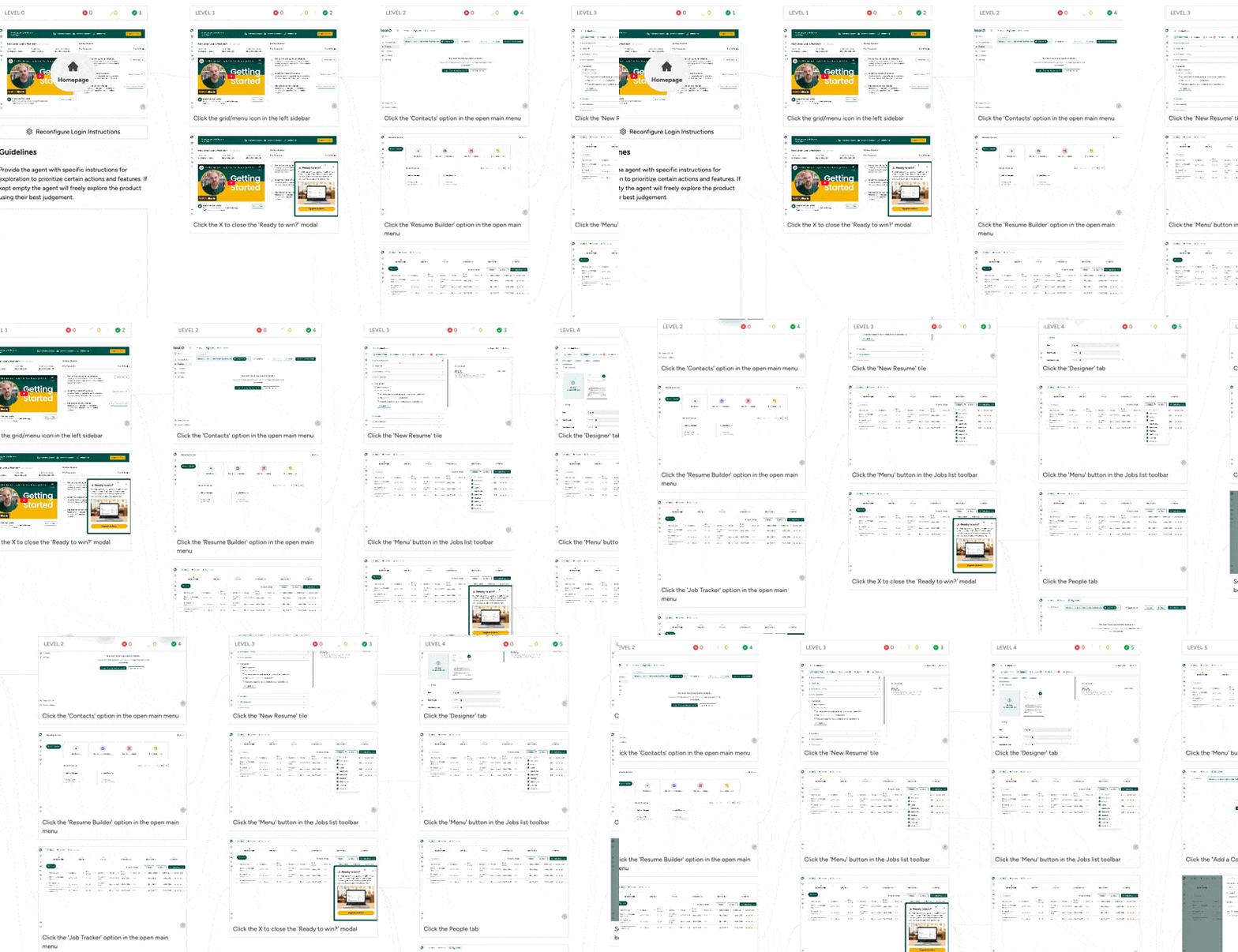
1. AI explores your product automatically
Captures:
Screenshots
Gifs
Notes
User flows
Capabilities
2. Builds a product knowledge base
This becomes your “source of truth” for all content.
3. Generates accurate BOFU content
Using proven frameworks for:
Comparisons
Alternatives
Use cases
Feature guides
Integrations
Landing pages
4. Scales production for small teams
Even a 1-person team becomes a BOFU machine.
Conclusion: The Future of SaaS SEO Is BOFU + AI Search
Google-era SEO isn’t enough anymore.
AI search now decides:
Which tools get recommended
Which competitor wins a comparison
Which product appears in shortlists
Which SaaS companies stay relevant
To win, SaaS teams must create:
Product-rich content
Structured BOFU pages
Accurate product knowledge bases
AI-readable feature documentation
The companies that adopt AI-first BOFU content today will capture the next generation of high-intent buyers — while the rest fade from AI search visibility.
Coming Soon
Lashey Lewis
•
AI search is fundamentally changing how SaaS companies get discovered online. For years, SEO was driven by traditional search engines like Google — where keywords, backlinks, and on-page optimization were enough to secure visibility. But with the rise of AI Overviews, conversational search, and answer-based engines like ChatGPT Search, Perplexity, and Gemini, the rules have changed.
Today, SaaS brands are realizing something critical:
Your future customers won’t “search” the way they used to — they will ask AI.
And if your content isn’t built for AI systems to understand, trust, and extract from… you disappear.
This blog breaks down how AI search works, why BOFU content matters more than ever, and how modern SaaS marketers can adapt their strategy.
What Is AI Search?
AI search refers to search experiences powered by large language models (LLMs) instead of traditional keyword-matching algorithms.
Instead of scanning hundreds of blue links, users get:
Direct answers
Summaries
Recommendations
Product comparisons
Step-by-step responses
And the source content often comes from websites — but not in the way SEO teams are used to.
AI search engines collect structured facts, product details, features, comparisons, and opinionated insights from across the web and turn them into instant answers.
In other words:
AI search doesn’t rank your content — it extracts from it.
Why This Shift Matters for SaaS Companies
SaaS is one of the categories most impacted by AI search because users frequently ask questions like:
“Best CRM for small teams?”
“HubSpot vs Salesforce for startups?”
“Affordable alternatives to Notion?”
“Best project management tool with automation?”
“Which email marketing tool integrates with Stripe?”
These are bottom-of-funnel (BOFU) queries — and AI systems LOVE these because they are high-intent and answerable with structured comparisons.
Traditional SEO teams built blog posts around these.
But AI search needs something different.
The Problem With Traditional SaaS Content
Most SaaS content suffers from the same issues:
1. It's written for Google, not for AI systems
Google rewards SEO structure.
AI search rewards product truth and feature depth.
2. It lacks proprietary product knowledge
Most marketing teams don’t have access to:
Real screenshots
Real feature descriptions
Accurate integrations
Edge-case capabilities
Updated release details
Real user flows
Without this, content becomes generic — and AI systems ignore it.
3. AI hallucination becomes a real risk
When AI engines can't find accurate information about your product, they invent it.
This creates:
❌ Misaligned comparisons
❌ Wrong feature descriptions
❌ False claims about your product
❌ Lower placement in AI search
❌ Less trust from potential buyers
4. Lean teams don’t have time to fix it
Most SaaS teams operate with:
No PMM (or an overloaded one)
1–3 content team members
A product team that is too busy for marketing
No structured product knowledge base
So BOFU content never gets built — or gets built too slow.
How AI Search Actually Reads Your Content
Traditional search engines “crawl” content.
AI search systems interpret and learn from content.
They look for:
1. Feature Depth
Is your product clearly described?
Are the capabilities well-explained?
2. Comparability
Can your content be used for:
“X vs Y”
“X alternatives”
“Best tools for ___”
3. Product Truth
AI models check for consistency across sources.
If your content conflicts with competitors or outdated docs, you get ignored.
4. Content Structure
AI search prefers:
Feature tables
Clear benefits
Structured sections
Screenshots
Use cases
Pros & cons
5. Internal linking & relationships
AI systems understand your product better when your website is internally connected:
Product → Feature → Use case → Comparison → Category
The more structured your content, the more AI can use it.
Why BOFU Content Becomes the New SEO Engine
AI search engines prefer BOFU content because:
It answers high-intent queries
It contains specific, factual product information
It avoids fluff
It can be structured into knowledge
It helps generate comparisons, rankings, and recommendations
Your product pages, feature pages, comparisons, and alternatives become the primary fuel for AI search.
In fact:
If you’re not creating BOFU content, you are invisible in AI-driven search.
What SaaS Teams Need To Do to Stay Relevant
To win in the new search era, SaaS teams need to shift from blog-based SEO to product-based content systems.
Here’s the new playbook:
1. Capture product truth proactively
AI needs accurate product information.
That means:
Screenshots
Feature definitions
Integrations
User flows
Gifs/videos
Release notes
Capabilities & limits
The more structured the truth → the more AI trusts your product.
2. Build a product-first content knowledge base
Don’t rely on blogs.
Build structured product pages that include:
Feature breakdowns
Comparison tables
Alternative lists
Use cases
Industry workflows
Product snapshots
This makes your content AI-readable.
3. Create BOFU content at scale
Because AI search is competitive, one article is not enough.
SaaS teams must produce:
Multiple comparison pages
Multiple alternatives
Feature pages
Use case pages
Competitor analyses
Category deep dives
But this is impossible manually — which brings us to the next step.
4. Use AI (the right way) to scale BOFU
Generic AI tools (ChatGPT, Claude) hallucinate product details because they rely on internet data.
They don’t know your actual product.
Modern SaaS teams use product-trained AI to generate accurate BOFU content:
Zero hallucinations
Accurate screenshots
Updated product truth
Structured templates
Repeatable frameworks
This is where platforms like BOFU.ai become game-changing.
How BOFU.ai Helps SaaS Teams Win in AI Search
BOFU.ai is built specifically for AI search + BOFU content.
It solves the biggest challenges:
1. AI explores your product automatically
Captures:
Screenshots
Gifs
Notes
User flows
Capabilities
2. Builds a product knowledge base
This becomes your “source of truth” for all content.
3. Generates accurate BOFU content
Using proven frameworks for:
Comparisons
Alternatives
Use cases
Feature guides
Integrations
Landing pages
4. Scales production for small teams
Even a 1-person team becomes a BOFU machine.
Conclusion: The Future of SaaS SEO Is BOFU + AI Search
Google-era SEO isn’t enough anymore.
AI search now decides:
Which tools get recommended
Which competitor wins a comparison
Which product appears in shortlists
Which SaaS companies stay relevant
To win, SaaS teams must create:
Product-rich content
Structured BOFU pages
Accurate product knowledge bases
AI-readable feature documentation
The companies that adopt AI-first BOFU content today will capture the next generation of high-intent buyers — while the rest fade from AI search visibility.
Coming Soon
Lashey Lewis
•
AI search is fundamentally changing how SaaS companies get discovered online. For years, SEO was driven by traditional search engines like Google — where keywords, backlinks, and on-page optimization were enough to secure visibility. But with the rise of AI Overviews, conversational search, and answer-based engines like ChatGPT Search, Perplexity, and Gemini, the rules have changed.
Today, SaaS brands are realizing something critical:
Your future customers won’t “search” the way they used to — they will ask AI.
And if your content isn’t built for AI systems to understand, trust, and extract from… you disappear.
This blog breaks down how AI search works, why BOFU content matters more than ever, and how modern SaaS marketers can adapt their strategy.
What Is AI Search?
AI search refers to search experiences powered by large language models (LLMs) instead of traditional keyword-matching algorithms.
Instead of scanning hundreds of blue links, users get:
Direct answers
Summaries
Recommendations
Product comparisons
Step-by-step responses
And the source content often comes from websites — but not in the way SEO teams are used to.
AI search engines collect structured facts, product details, features, comparisons, and opinionated insights from across the web and turn them into instant answers.
In other words:
AI search doesn’t rank your content — it extracts from it.
Why This Shift Matters for SaaS Companies
SaaS is one of the categories most impacted by AI search because users frequently ask questions like:
“Best CRM for small teams?”
“HubSpot vs Salesforce for startups?”
“Affordable alternatives to Notion?”
“Best project management tool with automation?”
“Which email marketing tool integrates with Stripe?”
These are bottom-of-funnel (BOFU) queries — and AI systems LOVE these because they are high-intent and answerable with structured comparisons.
Traditional SEO teams built blog posts around these.
But AI search needs something different.
The Problem With Traditional SaaS Content
Most SaaS content suffers from the same issues:
1. It's written for Google, not for AI systems
Google rewards SEO structure.
AI search rewards product truth and feature depth.
2. It lacks proprietary product knowledge
Most marketing teams don’t have access to:
Real screenshots
Real feature descriptions
Accurate integrations
Edge-case capabilities
Updated release details
Real user flows
Without this, content becomes generic — and AI systems ignore it.
3. AI hallucination becomes a real risk
When AI engines can't find accurate information about your product, they invent it.
This creates:
❌ Misaligned comparisons
❌ Wrong feature descriptions
❌ False claims about your product
❌ Lower placement in AI search
❌ Less trust from potential buyers
4. Lean teams don’t have time to fix it
Most SaaS teams operate with:
No PMM (or an overloaded one)
1–3 content team members
A product team that is too busy for marketing
No structured product knowledge base
So BOFU content never gets built — or gets built too slow.
How AI Search Actually Reads Your Content
Traditional search engines “crawl” content.
AI search systems interpret and learn from content.
They look for:
1. Feature Depth
Is your product clearly described?
Are the capabilities well-explained?
2. Comparability
Can your content be used for:
“X vs Y”
“X alternatives”
“Best tools for ___”
3. Product Truth
AI models check for consistency across sources.
If your content conflicts with competitors or outdated docs, you get ignored.
4. Content Structure
AI search prefers:
Feature tables
Clear benefits
Structured sections
Screenshots
Use cases
Pros & cons
5. Internal linking & relationships
AI systems understand your product better when your website is internally connected:
Product → Feature → Use case → Comparison → Category
The more structured your content, the more AI can use it.
Why BOFU Content Becomes the New SEO Engine
AI search engines prefer BOFU content because:
It answers high-intent queries
It contains specific, factual product information
It avoids fluff
It can be structured into knowledge
It helps generate comparisons, rankings, and recommendations
Your product pages, feature pages, comparisons, and alternatives become the primary fuel for AI search.
In fact:
If you’re not creating BOFU content, you are invisible in AI-driven search.
What SaaS Teams Need To Do to Stay Relevant
To win in the new search era, SaaS teams need to shift from blog-based SEO to product-based content systems.
Here’s the new playbook:
1. Capture product truth proactively
AI needs accurate product information.
That means:
Screenshots
Feature definitions
Integrations
User flows
Gifs/videos
Release notes
Capabilities & limits
The more structured the truth → the more AI trusts your product.
2. Build a product-first content knowledge base
Don’t rely on blogs.
Build structured product pages that include:
Feature breakdowns
Comparison tables
Alternative lists
Use cases
Industry workflows
Product snapshots
This makes your content AI-readable.
3. Create BOFU content at scale
Because AI search is competitive, one article is not enough.
SaaS teams must produce:
Multiple comparison pages
Multiple alternatives
Feature pages
Use case pages
Competitor analyses
Category deep dives
But this is impossible manually — which brings us to the next step.
4. Use AI (the right way) to scale BOFU
Generic AI tools (ChatGPT, Claude) hallucinate product details because they rely on internet data.
They don’t know your actual product.
Modern SaaS teams use product-trained AI to generate accurate BOFU content:
Zero hallucinations
Accurate screenshots
Updated product truth
Structured templates
Repeatable frameworks
This is where platforms like BOFU.ai become game-changing.
How BOFU.ai Helps SaaS Teams Win in AI Search
BOFU.ai is built specifically for AI search + BOFU content.
It solves the biggest challenges:
1. AI explores your product automatically
Captures:
Screenshots
Gifs
Notes
User flows
Capabilities
2. Builds a product knowledge base
This becomes your “source of truth” for all content.
3. Generates accurate BOFU content
Using proven frameworks for:
Comparisons
Alternatives
Use cases
Feature guides
Integrations
Landing pages
4. Scales production for small teams
Even a 1-person team becomes a BOFU machine.
Conclusion: The Future of SaaS SEO Is BOFU + AI Search
Google-era SEO isn’t enough anymore.
AI search now decides:
Which tools get recommended
Which competitor wins a comparison
Which product appears in shortlists
Which SaaS companies stay relevant
To win, SaaS teams must create:
Product-rich content
Structured BOFU pages
Accurate product knowledge bases
AI-readable feature documentation
The companies that adopt AI-first BOFU content today will capture the next generation of high-intent buyers — while the rest fade from AI search visibility.